
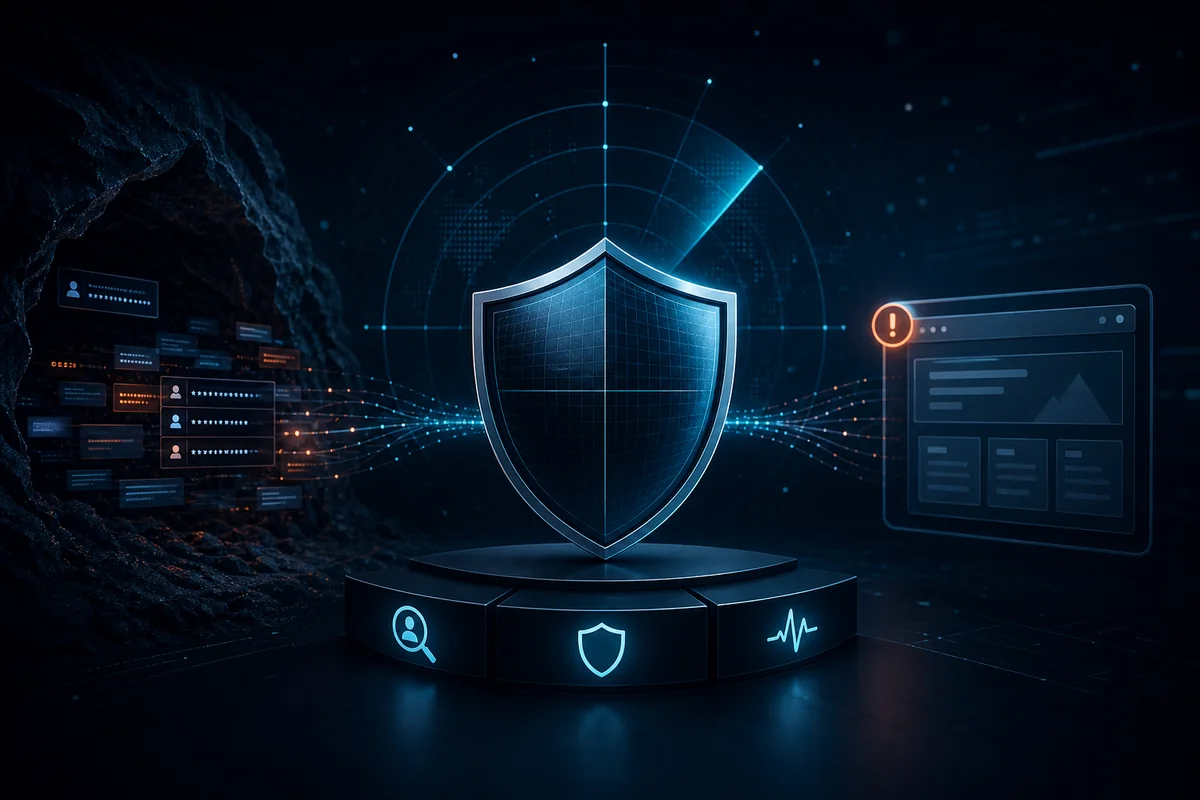
A password exposed in a criminal forum, a fake website imitating your payment page and an actively exploited software vulnerability are all security signals. They are not the same signal, and responding to them requires different information. This is why buying a tool labelled “monitoring” without defining the question often creates noise instead of protection.
For businesses moving more customer service, payments, operations and records online, the practical goal is simple: find important exposure early enough to act. Dark web monitoring, brand monitoring and threat intelligence each contribute a different part of that early-warning system.
The difference in one minute
| Service | Main question | Typical signal |
|---|---|---|
| Dark Web Monitoring | Has private access or data been exposed? | Leaked employee credentials |
| Brand Monitoring | Is someone publicly pretending to be us? | Fake domain or social profile |
| Threat Intelligence | Which external threats should we act on? | Exploited vulnerability or campaign |
1. Dark web monitoring: hidden exposure
Dark web monitoring checks agreed sources for information connected to an organisation: employee email addresses, passwords, access tokens, internal documents, customer data references or discussions involving the company. The useful output is not a dramatic screenshot. It is a validated alert that explains what was found, how confident the finding is, which account or system may be affected and what the owner should do.
The most common business use is credential exposure. A password can be stolen through phishing, reused after an unrelated breach or extracted from an infected employee device. The organisation may have no visible incident yet. The exposure becomes dangerous when an attacker uses it against email, VPN, cloud or administrative services.
CISA's ransomware guidance recommends considering credential-monitoring services and pairing them with stronger identity controls. Monitoring is the alarm; access control and incident response are what reduce the damage.
2. Brand monitoring: public impersonation
Brand monitoring watches the public digital surface for lookalike domains, cloned websites, phishing pages, fake support accounts, executive impersonation, misleading applications and fraudulent advertisements. These attacks target customer trust rather than a technical vulnerability in your own system.
A fintech, school, hospital, travel company or e-commerce business may be impersonated through a domain that changes one character, a fake Facebook page offering support, or a cloned payment page shared through messages. The company might remain technically secure while customers are still harmed.
A good workflow establishes the official names, domains, executives, applications and social profiles first. New findings are then validated for intent, similarity, activity and potential harm. Evidence is preserved before reporting to the registrar, hosting provider or platform. Takedown cannot be guaranteed because the decision belongs to those third parties, but complete evidence improves the process.
3. Threat intelligence: relevant external context
Threat intelligence converts external observations into defensive decisions. It can include malicious IP addresses and domains, malware indicators, newly exploited vulnerabilities, attack trends and sector-specific advisories. A raw feed is rarely useful to a small team. The value comes from relevance, confidence, timeliness and a recommended action.
For example, “a new vulnerability exists” is information. “Your internet-facing appliance is affected, exploitation is being observed, and these are the temporary controls and patch steps” is actionable intelligence.
A useful intelligence service should support a simple lifecycle: prepare, prevent, detect, respond and recover. It should help the organisation change a control or make a decision, not simply collect more indicators.
Which service should your business choose?
- Start with dark web monitoring when employee email, remote access, cloud accounts or sensitive records create material credential risk.
- Start with brand monitoring when customers find you, contact you, log in or pay online and impersonation could create fraud.
- Start with filtered threat intelligence when an IT or security team needs help prioritising vulnerabilities and campaigns across many systems.
- Combine all three when the organisation is regulated, highly visible or responsible for financial, health, citizen or customer data.
What monitoring does not replace
These services do not replace VAPT, patching, backups, multi-factor authentication, secure configuration or staff awareness. VAPT tests the weaknesses in assets you operate. Monitoring looks outward for evidence and changing threats. Training helps people recognise and report attacks. The strongest programme connects the findings.
A useful security signal has an owner, a confidence level, a business impact and a next action. Without those four elements, monitoring becomes another dashboard.
Questions to ask a provider
- What assets and identities are included in the scope?
- Which sources and channels are monitored?
- Are alerts validated by a person before delivery?
- How are urgency and confidence communicated?
- What response guidance is included?
- How is client data handled and retained?
- Can the service integrate with our incident process?
A sensible starting point
Begin with a short exposure baseline covering official domains, employee email patterns, key public identities and the technologies that matter most. Use the results to decide whether continuous dark web monitoring, brand monitoring, threat intelligence or a combined service is justified.
Explore Dark Web Monitoring, Brand Monitoring and Threat Intelligence Feeds, or request a scoped consultation.
Turn the guidance into practical action.
Choose the service closest to your current risk, technology goal or team requirement.